

KWWD – Cape May County Airport
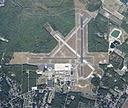
The U.S. Naval Air Station at Cape May, New Jersey, was established in October 1917 as a seaplane and lighter-than-air patrol station. The First Marine Aeronautic Company were trained at Cape May. At the end of World War I, US Navy seaplanes–and a lone dirigible-conducted antisubmarine patrols along the New Jersey coast from this site. After the first World War, the Navy converted the station to a construction site for lighter-than-aircraft, and turned the property over to the U.S. Lifesaving Service.
The first Coast Guard Air Station Cape May was commissioned in 1926, and was equipped with one seaplane and one amphibian aircraft — both of which were used for rescue and anti-smuggling operations. Originally assigned to Coast Guard Section Base 9, Cape May, three aircraft, and the pilots who flew them, became Air Station Cape May. Their original mission was to patrol the shores of New Jersey to locate rum smugglers during Prohibition. The various types of aircraft which flew out of Air Station Cape May were hangared in a former Navy blimp hanger and launched into the harbor on a wooden ramp.
In the 1930s, an aviation school for enlisted men was set up at Cape May. The Coast Guard maintained its operations until 1938 when the Navy returned. During World War II Navy pilots trained at Cape May for operations on aircraft carriers. By 1941, Cape May was called NAS Rio Grande (New Jersey). Due to confusion with Rio Grande Texas, the name was changed to NAS Wildwood in 1943. Navy operations continued throughout the Second World War until 1946 when the station was returned to Coast Guard control.
Following the end of World War II, Naval Air Station Wildwood was deemed excess to U.S. Navy requirements, and was subsequently deeded to the local government for transition to a civilian airport which is still in operation today as Cape May County Airport. In 1948 the site became the U.S. Coast Guard Recruit Training Center.
A new Air Station was commissioned on 17 July 1969. In the mid-1960s, the United States witnessed a rapid growth in recreational boating. In response, Congress reestablished Coast Guard Air Station Cape May. This re-establishment of Air Station Cape May included two HH-52 Sea Guards, 13 officers and 33 enlisted crew. A third HH-52 was added to the Air Station’s complement in the early 1970s.
In 1987, the Coast Guard replaced the aging HH-52 with the HH-65 Dolphin. Group-Air Station Cape May was instrumental in the test and design phase of several HH-65 upgrades. Cape May Air Station thrived for another decade until it officially closed on April 28, 1998. Group-Air Station Atlantic City in its present form is the result of a Coast Guard aviation streamlining initiative to realign unit location with the capabilities of today’s modern aircraft. Air Station Brooklyn and Group-Air Station Cape May combined their resources at the newly constructed $13 million facility at Atlantic City International Airport, which opened June 8, 1998.
Leave a Reply
You must be logged in to post a comment.