

This is default featured slide 1 title
You can completely customize the featured slides from the theme theme options page. You can also easily hide the slider from certain part of your site like: categories, tags, archives etc. More »
This is default featured slide 2 title
You can completely customize the featured slides from the theme theme options page. You can also easily hide the slider from certain part of your site like: categories, tags, archives etc. More »

This is default featured slide 3 title
You can completely customize the featured slides from the theme theme options page. You can also easily hide the slider from certain part of your site like: categories, tags, archives etc. More »

This is default featured slide 4 title
You can completely customize the featured slides from the theme theme options page. You can also easily hide the slider from certain part of your site like: categories, tags, archives etc. More »

This is default featured slide 5 title
You can completely customize the featured slides from the theme theme options page. You can also easily hide the slider from certain part of your site like: categories, tags, archives etc. More »
PMDY – Henderson Field (at Midway Atoll)
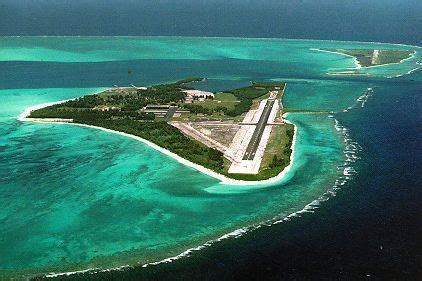
Roughly equidistant between North America and Asia, Midway is the only island in the Hawaiian Archipelago that is not part of the state of Hawaii. From 1941 until 1993, the atoll was the home of Naval Air Facility Midway Island, which played a crucial role in the Battle of Midway, June 4–6, 1942. Aircraft based at the then-named Henderson Field on Eastern Island joined with Unitedd States Navy ships and planes in an attack on a Japanese battle group that sank four carriers and one heavy cruiser and defended the atoll from invasion. The battle was a critical Allied victory and a significant turning point of the Pacific campaign of World War II.
The atoll was first initially sighted on July 5, 1859, by Captain N.C. Brooks, of the sealing ship Gambia. The islands were named the “Middlebrook Islands”. Brooks claimed Midway for the United States under the Guano Islands Act of 1856, which authorized Americans to occupy uninhabited islands temporarily to obtain guano. On August 28, 1867, Captain William Reynolds of USS Lackawanna formally took possession of the atoll for the United States and the name was changed to “Midway.” The atoll was the first Pacific island annexed by the United States as the Unincorporated Territory of Midway Island and was administered by the United States Navy.
The first attempt at settlement was in 1870 when the Pacific Mail Steamship Company started a project of blasting and dredging a ship channel through the reef to the lagoon using money put up by the U.S. Congress. The purpose was to establish a mid-ocean coaling station to avoid the high taxes imposed at ports controlled by the Kingdom of Hawai’i. The project was a failure, and the USS Saginaw evacuated the channel project’s workforce in October 1870. The ship ran aground on 21 October at Kure Atoll, stranding 93 men. On 18 November, five men set out in a small boat to seek help. On 19 December, four of the men perished when the boat was upset in the breakers off of Kauai. The lone survivor reached the U.S. Consulate in Honolulu on Christmas Eve.
In 1903, workers for the Commercial Pacific Cable Company took up residence on the island as part of the effort to lay a trans-Pacific telegraph cable. To make the island more verdant, these workers introduced many non-native species to the island, including the canary, cycad, Norfolk Island pine, she-oak/Ironwood, coconut, and various deciduous trees; along with some 9,000 short tons (8,200 t) of soil from Oahu and Guam. Ants, cockroaches, termites, centipedes, and countless other organisms were unintentionally introduced to Midway and the soil.
On January 20, 1903, the United States Navy opened a radio station in response to complaints from cable company workers about Japanese squatters and poachers. Between 1904 and 1908, President Theodore Roosevelt stationed 21 Marines on the island to end wanton destruction of bird life and keep Midway safe as a U.S. possession, protecting the cable station.
In 1935, operations began for the Martin M-130 flying boats operated by Pan American Airlines. The M-130s island-hopped from San Francisco to the Republic of China, providing the fastest and most luxurious route to the Far East and bringing tourists to Midway until 1941. Only the very wealthy could afford the trip, which in the 1930s cost more than three times the annual salary of an average American. With Midway on the route between Honolulu and Wake Island, the flying boats landed in the atoll and pulled up to a float offshore in the lagoon. Tourists transferred to the Pan Am Hotel or the “Gooneyville Lodge”, named after the ubiquitous “Gooney birds” (albatrosses), in this case Laysan Albatross and Black-footed Albatross.
The military importance of the location of Midway in the Pacific included its use as a convenient refueling stop on transpacific flights and for Navy ships. Beginning in 1940, as tensions with the Japanese rose, Midway was deemed second only to Pearl Harbor in importance to the protection of the U.S. West Coast. Airstrips, gun emplacements, and a seaplane base quickly materialized on the tiny atoll. The channel was widened, and Naval Air Station Midway was completed. Midway was also an important submarine base.
On February 14, 1941, President Franklin Roosevelt issued Executive Order 8682 to create naval defense areas in the central Pacific territories. The proclamation established the “Midway Island Naval Defensive Sea Area”, which encompassed the territorial waters between the extreme high-water marks and the three mi (4.8 km) marine boundaries surrounding Midway. “Midway Island Naval Airspace Reservation” was also established to restrict access to the airspace over the naval defense sea area. Only U.S. government ships and aircraft were permitted to enter the naval defense areas at Midway Atoll unless authorized by the Secretary of the Navy.
Midway’s importance to the U.S. was brought into focus on December 7, 1941, when the Japanese attacked Pearl Harbor. Two destroyers bombarded Midway on the same day; this was the first Bombardment of Midway. A Pan-Am flying clipper stopped at Midway and evacuated passengers and Pan-American employees from Wake island, which had also been attacked earlier that day. The clipper was on its usual passenger route to Guam when the attack on Pearl Harbor happened; it then made a return journey going from Wake to Midway, Honolulu, and back to the USA.
A Japanese submarine bombarded Midway on February 10, 1942. In total, Midway had been attacked four times between 7 December 1941 and the Japanese submarine attack of 10 February 1942.
Four months later, on June 4, 1942, a major naval battle near Midway resulted in the U.S. Navy inflicting a devastating defeat on the Imperial Japanese Navy. Four Japanese fleet aircraft carriers, Akagi, Kaga, Hiryū and Sōryū, were sunk, along with the loss of hundreds of Japanese aircraft, losses that the Empire of Japan would never be able to replace. The U.S. lost the aircraft carrier Yorktown, along with a number of its carrier- and land-based aircraft that were either shot down by Japanese forces or bombed on the ground at the airfields. The Battle of Midway was, by most accounts, the beginning of the end of the Imperial Japanese Navy’s control of the Pacific Ocean.
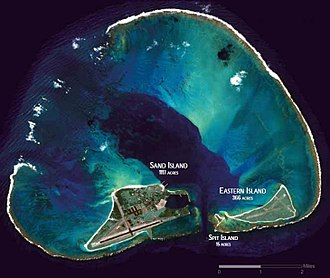
Starting in July 1942, a submarine tender was always stationed at the atoll to support submarines patrolling Japanese waters. In 1944, a floating dry dock joined the tender. After the Battle of Midway, a second airfield was developed on Sand Island, which is the only remaining runway in Midway Atoll. This work necessitated enlarging the island through landfill techniques that, when completed, more than doubled its size.
From August 1, 1941, to 1945, U.S. military forces occupied Midway. In 1950, the Navy decommissioned Naval Air Station Midway, only to re-commission it again to support the Korean War. Thousands of troops on ships and aircraft stopped at Midway for refueling and emergency repairs. Midway Island was a Naval Air Facility from 1968 to September 10, 1993.
With about 3,500 people living on Sand Island, Midway supported the U.S. troops during the Vietnam War. In June 1969, President Richard Nixon met South Vietnamese President Nguyen Van Thieu at the Officer-in-Charge house, also known as “Midway House.”
In 1978, the Navy downgraded Midway from a Naval Air Station to a Naval Air Facility, and many personnel and dependents began leaving the island. With the war in Vietnam over and with the introduction of reconnaissance satellites and nuclear submarines, Midway’s significance to U.S. national security was diminished. The World War II facilities at Sand and Eastern Islands were listed on the National Register of Historic Places on May 28, 1987, and were simultaneously added as a National Historic Landmark. As part of the Base Realignment and Closure process, the Navy facility on Midway has been operationally closed since September 10, 1993. However, the Navy assumed responsibility for cleaning up environmental contamination.
On October 31, 1996, President Bill Clinton signed Executive Order 13022, which transferred the jurisdiction and control of the atoll to the United States Department of the Interior. The FWS assumed management of the Midway Atoll National Wildlife Refuge. The last contingent of Navy personnel left Midway on June 30, 1997, after an ambitious environmental cleanup program was completed.
https://airportguide.com/airport/info/MDY
https://en.wikipedia.org/wiki/Henderson_Field_(Midway_Atoll)
31E Eagles Nest Airport

Eagles Nest Airport is a privately owned public-use airport serving only general aviation aircraft. It was established as a private strip to cater to the burgeoning interest in general aviation post-World War II. Over the years, it transitioned from a simple dirt strip to a more developed facility. It has been in operation since the 1960s and was upgraded in April 1989 after the Manahawkin Airport along SR 72 was sold and the land redeveloped,. The airport is located two nautical miles north of the community of West Creek, in Eagleswood Township, New Jersey.
M78 – Malvern Municipal Airport

Malvern Municipal Field (M78) is a city-owned general aviation airport in central Arkansas, located 3 miles southeast of the city center, the airport is served by one runway: Runway 4- 22. The airport’s origins can be traced back to the post-war 1950s, with the initial focus on general aviation and flight training.
